


Rivets are fastening elements widely used in a variety of industrial and construction applications. These small but sturdy joint solutions play a key role in building structures, manufacturing products, and joining different materials.
In this blog post from Remaches Tudela, we will tell you what a rivet is, what materials they are made of, what they are used for, how they work, when they are used, and what are the most commonly used rivets. Additionally, we will discuss the eternal question: rivet or screw, which is the better option? Let’s get started!
What is a rivet?
Rivets are fastening elements used in a wide variety of industrial and construction applications to securely and permanently join two or more pieces. Unlike other joining methods, such as screws or welds, rivets do not require the use of electric tools or heat, making them a versatile and easy-to-use option.
These devices consist of a body that is deformed in a controlled manner when hammered or compressed, using another tool or a shaft or nail mounted on the body, creating a solid and reliable joint.
Their versatility makes them suitable for a wide range of materials, from metals and plastics to wood and composite materials. Rivets are essential in the construction of structures, the manufacture of products, and many other applications where secure material joining is crucial.
What material are rivets made of?
Rivets can be made from a variety of materials, and the choice of material depends on the specific application. Some of the most common materials used to make rivets include:
Steel
Steel rivets are sturdy and resistant to corrosion, making them suitable for industrial and structural applications.
Aluminum
Aluminum rivets are lightweight and have good corrosion resistance. They are ideal for applications where weight is an important consideration.
Brass
Brass rivets are appreciated for their aesthetic appearance and corrosion resistance. They are used in applications where an attractive appearance is required.
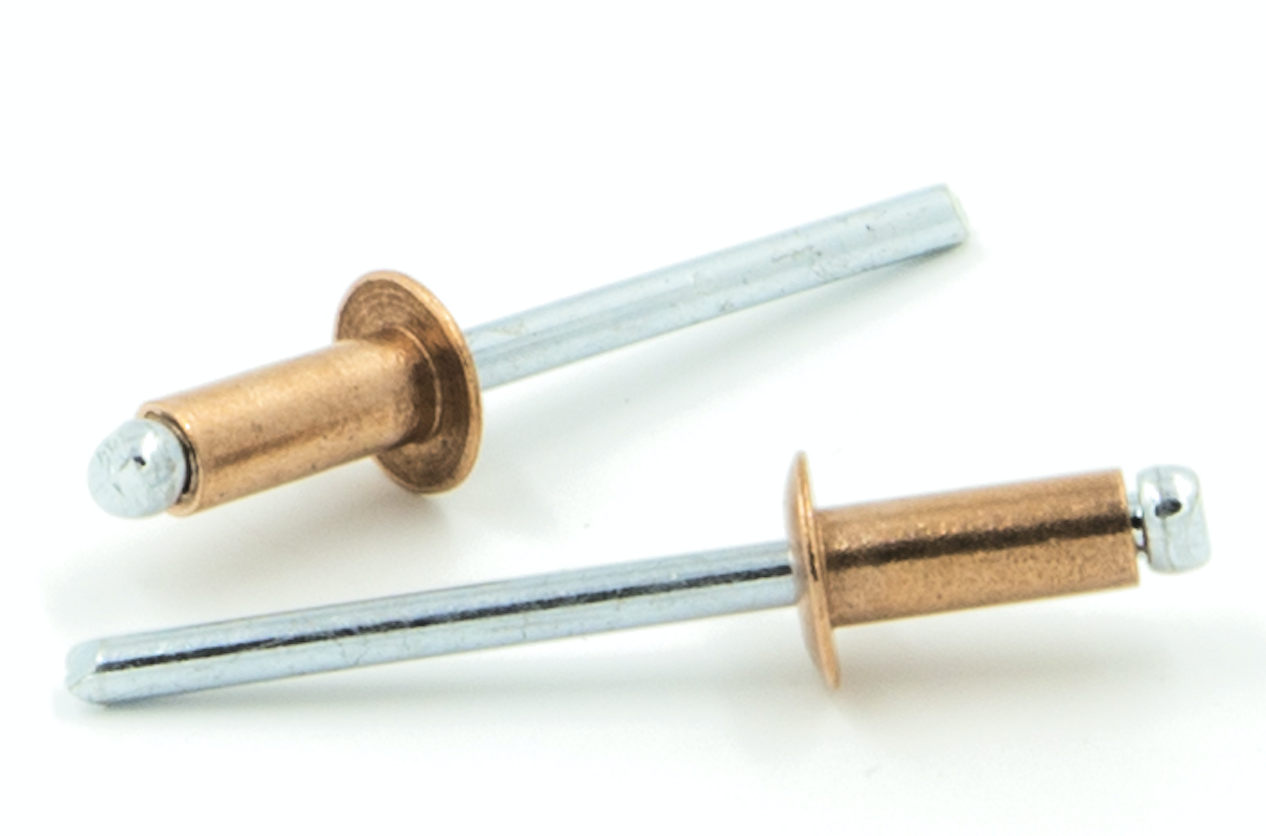
Copper
Copper rivets are excellent electrical conductors and are used in electrical and electronic applications.
Stainless Steel
Stainless steel rivets are highly resistant to corrosion and are used in marine and chemical environments.
Plastic
In applications where electrical insulation or resistance to chemicals is required, plastic rivets are used.
What are rivets used for?
Rivets are used in a wide variety of applications across various industries. Some of the most common uses include:
Construction
In construction, rivets are used to join beams, metal structures, and building components.
Automotive
Rivets are fundamental in the automotive industry for assembling bodies, panels, and components.
Aviation and aerospace
In these industries, rivets are crucial for manufacturing aircraft and spacecraft due to their lightness and strength.
Machinery manufacturing
Rivets are used in the production of machinery and industrial equipment.
Electronics
In electronics, copper and aluminum rivets are essential for connecting circuits and components.
Furniture
In the furniture industry, rivets are used to assemble chairs, tables, and other furniture.
Container and Packaging Manufacturing
Rivets ensure the structural integrity of metal containers and packaging.

How does a rivet work?
The operation of a rivet is relatively simple but highly effective. When a rivet is inserted through the pieces to be joined, a special tool called a riveter is placed on the end of the rivet’s protruding shaft.
The riveter applies force that flattens or bends the end of the body, thus forming a head on the other side. This flattened or bent head securely holds the pieces together. The resulting joint is permanent and cannot be disassembled without destroying the rivet.
When is a rivet used?
Rivets are used in situations where a strong and permanent connection between materials is needed. Some of the most common situations in which rivets are used include:
- When a non-detachable joint is required: Rivets are ideal when a connection that should not be easily disassembled is needed.
- In high-load applications: Due to their strength, rivets are used in applications where the parts will be subjected to significant loads.
- Where resistance to vibration is needed: Rivets are effective at resisting vibration and fatigue due to their solid joint nature.

What are the most commonly used rivets?
There are several types of rivets, each designed for specific applications. Some of the most commonly used rivets include:
Standard rivets
Designed to ensure a solid and long-lasting fastening in standard riveting applications (preformed or flat metal sheets or plates).
Blind rivets
These rivets are used when only one side of the parts to be joined is accessible, making them ideal for applications where the other side cannot be reached.
Drive rivets
Drive rivets are used in high-strength applications and allow for uniform load distribution.
Pull rivets
These are special rivets designed to join soft materials, such as plastic.
Sealed rivets
The sealed body ensures waterproofing between the body and the shaft. Available in different materials and head styles, these rivets are not recommended for plastic and soft materials.

Rivet or screw, which is the better option?
The choice between a rivet and a screw depends on the specific needs of the application. Rivets are ideal when a permanent and robust union is sought, while screws allow for disassembly and reuse. The choice also depends on the type of materials being joined and the load they will be exposed to. In many cases, a combination of rivets and screws is used in a structure or product to take advantage of the benefits of both.
Advantages of rivets
- Strength and stability: Rivets provide a solid and stable joint that can withstand heavy loads and resist vibration.
- Permanence: Once rivets are installed, they are difficult to disassemble without damaging the structure, providing greater security against unauthorized or accidental disassembly.
- Low Cost: Rivets are usually more economical than more complex fastening systems, such as screws and nuts.
- Speed of installation: The installation of rivets can be quicker than that of screws, especially in mass production applications.
Advantages of Screws:
- Disassembly and reuse: screws allow for the disassembly and reassembly of parts, which is useful in situations where maintenance or modifications are needed.
- Adjustability: screws allow for the adjustment of the tension and position of the joined pieces, which can be important in applications where precise alignment is essential.
- Variety of materials: screws are available in a wide range of materials and coatings, allowing them to be adapted to corrosive or special environments.
- Higher load capacity in some sases: in applications where load capacity is critical, such as in bridge construction, screws are often preferred due to their ability to support extremely heavy loads.
As you can see, the choice between a rivet and a screw depends on the specific needs of the application. If a permanent and resistant union is sought, rivets are the right choice. On the other hand, if disassembly or adjustment is required, screws are more appropriate. In many cases, both are used together to take advantage of the benefits of each.
At Remaches Tudela, we specialize in the manufacturing of lacquered rivets by drum and by hand, providing unmatched quality for our products that require a perfect aesthetic finish. This allows us to offer a more competitive and rapid service, controlling 100% of the process.
If you are interested in learning more about rivets and how they can be applied in your specific industry or project, we recommend visiting our website by clicking here. If, on the other hand, you need more information, feel free to contact us, we will be delighted to help you.